
Specs are compiled from manufacturer listings and verified buyer reviews and can change over time — please confirm the key details on the product page before buying.
If your sashimi slices come out ragged and torn, the problem is usually the blade, not your hands. A real yanagiba uses a single-bevel edge — one side ground sharp, the other left flat — so the knife glides through fish in one long pull instead of sawing at the flesh. That one detail is the whole reason sushi chefs reach for this shape, and it is also the detail most listings hide. Below you will find the nine knives that actually get it right, sorted by what each one is best at.
This guide is built by comparing the manufacturers’ published specifications and the patterns across verified customer reviews, so you get each pick’s real strengths and trade-offs instead of marketing spin.
Here is how the nine picks in this yanagiba sushi knife roundup actually differ in steel, bevel and handle.
Top Picks


How To Choose The Best Yanagiba Sushi Knife
The honest starting point: you cannot judge a yanagiba by its photos. Two knives can look identical on a listing and behave completely differently in your hand, because the grind on the back face and the hardness of the steel decide everything. Four things carry the real weight.
Start with the bevel, not the brand
A yanagiba is a single-bevel knife, meaning the front is ground to an edge and the back is hollowed into a shallow concave face (called urasuki) that lets the slice release. If a listing shows a symmetrical edge with two grinds, it is a double-bevel sashimi knife wearing a yanagiba label. You will feel the difference the first time you cut tuna: a single bevel pulls clean, a double bevel drags and tears.
Match blade length to the fish in front of you
Small fillets and home counters are happy with a blade around 210 to 240 mm. Whole salmon sides and long single-stroke cuts want 270 mm or more, because the length lets the knife travel the whole fillet in one motion instead of two. If your cutting board is short, a very long blade becomes awkward, so measure the board before you fall for a 12-inch knife.
Understand steel type before you commit
High-carbon stainless steels such as VG-10 and similar alloys hold an edge longer but ask for more careful washing and drying. Softer stainless is easier to sharpen and more forgiving for a first single-bevel knife, though it dulls faster. Hardness figures in HRC tell you which side of that trade-off a blade sits on, and anything in the high 50s to low 60s is a working kitchen knife.
Think about the handle for wet work
Fish prep means wet hands. A smooth lacquered wood handle that looks beautiful on a shelf can turn slippery mid-fillet, while a textured or octagonal shape gives your fingers something to lock onto. Wood that swells, or a rough finish that raises splinters, is worth knowing about before you buy rather than after.
Side-by-Side Comparison
| Model | Best For | Blade Length | Steel | Construction | Amazon |
|---|---|---|---|---|---|
| Kai Wasabi 8.25” Yanagiba Knife★ Best Overall | First single-bevel knife and sharpening practice | 8.25 inches | High-carbon stainless | Stamped | Amazon |
| HOSHANHO Sushi Knife 10″Sharpest Edge | Precise thin slicing on a budget | 10 inches | 10Cr15CoMoV high carbon | Forged | Amazon |
| Mercer Culinary Yanagi Sashimi, 12-InchLongest Reach | Long single-stroke cuts on big fish | 12 inches | High-carbon German | Stamped | Amazon |
| JapanBargain Yanagiba 9-1/2 inch, 2-Pack | Two knives for a shared or training kitchen | 9.5 inches | Molybdenum stainless | Forged | Amazon |
| MITSUMOTO SAKARI 10 Inch Sashimi Knife | Warm wood handle feel and light weight | 10 inches | Tungsten alloy | Forged | Amazon |
| KEEMAKE 11.5 inch Sashimi Knife VG10 | Long blade plus a hardened VG-10 core | 11.5 inches | VG-10 high carbon stainless | Stamped | Amazon |
| Kai Sekimagoroku Takuso 240 mm | All-stainless work knife you can rinse and rack | 9.4 inches | Molybdenum vanadium stainless | All stainless | Amazon |
| Masahiro Fukui Stainless Yanagi 270 mm | Busy prep days that test edge retention | 27 centimeters | MBS-26 stainless | Forged | Amazon |
| FINDKING Prestige Series Yanagiba 10.5 Inch | Gifting and presentation with a saya and box | 10.5 inches | Japanese SKD11 Damascus | Forged | Amazon |
Detailed Reviews
1. Kai Wasabi 8.25” Yanagiba Knife
Our pick — 4.5+★ from 750+ verified ratings; the strongest balance of quality and price.
The training knife that gets you slicing clean before you spend serious money
Learn on a knife that will forgive you. The Kai Wasabi runs an 8.25-inch high-carbon stainless blade with an item length of 13.25 inches overall and a stamped build, which keeps the edge thin enough to glide through a salmon fillet while staying easy to touch up. At 201.6 grams it sits light in the hand, so long pull cuts down the length of a fillet do not tire your wrist the way a heavy forged blade can.
What wins people over is the edge. Kai grinds this as a genuine single-bevel sushi knife, and owners describe tuna and sushi rolls parting in one clean stroke rather than snagging — one slice quality note mentions cuts as fine as 0.5mm. The high-carbon stainless also shrugs off corrosion and wear, and Kai supports it with free sharpening and honing, which is a real comfort when you are still learning to work a whetstone.
The grip is where this knife splits opinion, and honestly. The polypropylene-bamboo handle is symmetrical, which makes it equally usable for left and right hands, but it is a plain plastic-feeling shape rather than a warm wooden one. A few owners also treat this as a practice blade before stepping up to carbon steel, and the softer stainless does want regular honing. As owners put it, it is ideal for “practicing whetstone sharpening at 15° angle before upgrading to costly carbon knives.”
Where it earns its keep
- Sharpness is the point everyone lands on — fish and rolls part in one pull rather than tearing
- Stamped high-carbon stainless at 201.6 g stays light through a long slicing session
- Symmetrical handle works for both left- and right-handed cooks, unlike right-hand-only grinds
- Free sharpening and honing from Kai backs up a blade you will actually maintain
What to weigh first
- The polypropylene-bamboo handle is the most discussed gripe — expect a functional plastic feel, not a wood one
- Softer stainless needs honing more often than harder, pricier steels
- The back edge near the heel is sharp and angled toward the handle, so mind your finger
- Slightly bent or tilted blades have turned up on machine-made units
Grab this one: if you are learning single-bevel technique or cook sashimi a few times a month and want a sharp, light blade backed by free sharpening.
Hold off: if a wooden traditional handle matters to you, because this one is plastic through and through.
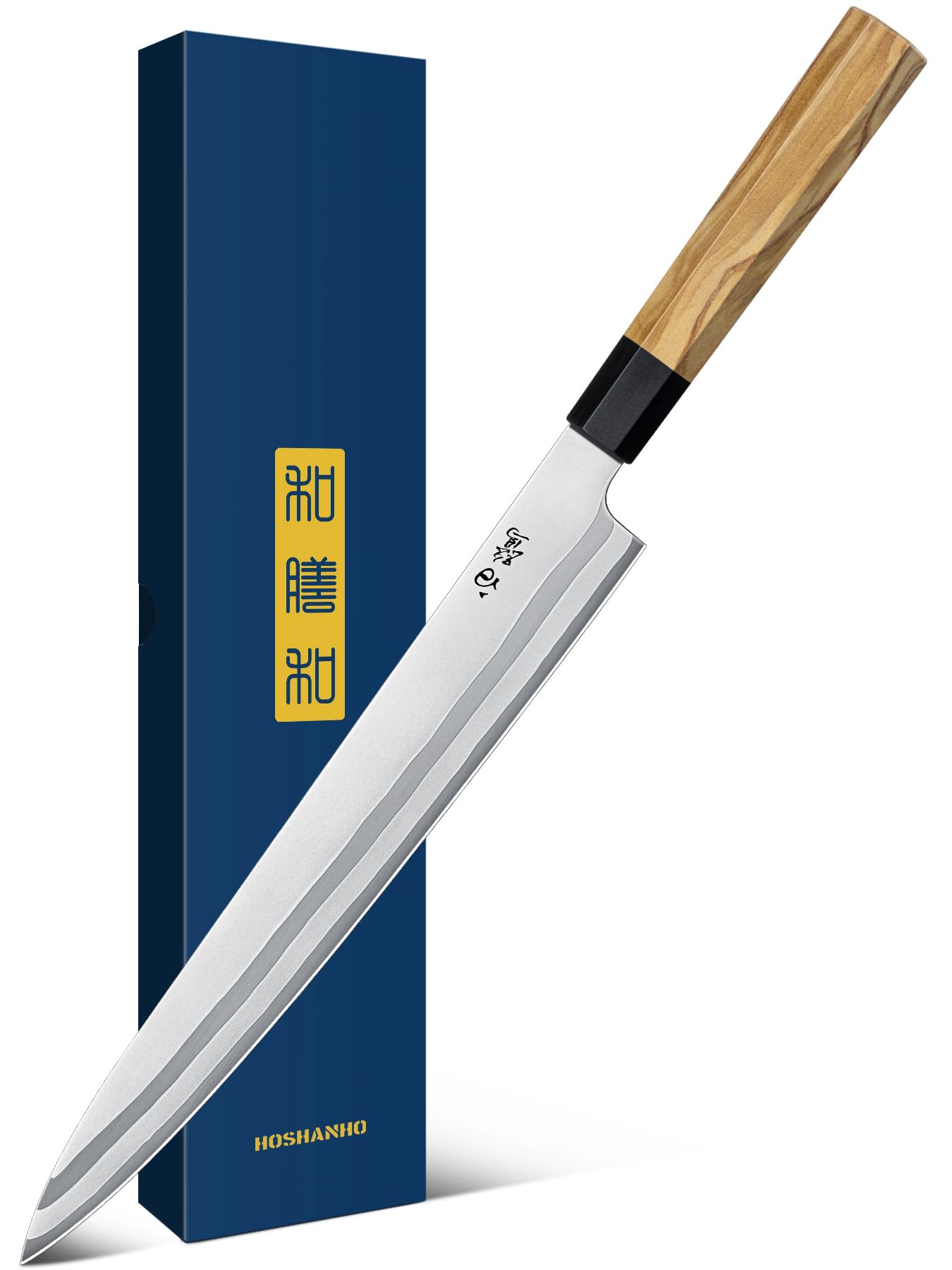
2. HOSHANHO Sushi Knife 10″
A 12-degree edge that shaves fish thin, with a catch for anyone who sharpens by hand
That 12° bevel angle is the number that decides whether this knife suits you. Most Japanese edges are ground at a steeper angle and European knives even more, so a 12° single bevel bites deeper and slices thinner — exactly what you want for sashimi. The blade is forged from 10Cr15CoMoV high-carbon steel and heat-treated to a stated 62 HRC, a hardness figure that points to strong wear resistance and an edge that should hold through repeated professional use.
The handling story is mixed but specific. The octagonal olive-wood handle is polished smooth to resist slipping and rotation, and the overall length of 10 inches delivers a feather-light 6.4-ounce blade. That light weight is a gift for thin slicing and a small annoyance for anyone who chops: several cooks found it lacked the momentum a heavier knife carries into a cut, and the large handle did not suit every hand.
The blade quality is what draws people in, with flawless single-stroke cuts the recurring theme. A fair warning before you buy: that fine 12° edge is hard to bring back with a standard pull-through sharpener and really wants a whetstone or an adjustable-angle sharpener. Buyers report: “Factory edge uneven—sharp near tip, ragged at heel/flat.”
The edge arithmetic: 12° bites deeper than a typical 15° Japanese grind, so thin sashimi slices part with less pressure and less cellular tearing.
The real cost of it: hard 62 HRC steel plus a shallow angle means you cannot treat this as a throwaway edge — budget for a whetstone and learn the motion.
It suits: the cook who wants genuinely thin sashimi cuts and is ready to maintain a fine edge properly.
Think twice: if you prefer a heavier knife with chopping momentum or sharpen with a standard pull-through.
3. Mercer Culinary Yanagi Sashimi Knife 12-Inch
Twelve inches of blade so a whole salmon side goes down in one motion
Length is the whole argument here, and the gap is real. Twelve inches of blade against the Kai Wasabi’s 8.25 inches is the difference between a knife that crosses a fillet in one stroke and one that needs a second pass. That single long pull is what separates clean sashimi from a slice with drag marks, and cooks who work through whole fish feel it immediately. The blade is high-carbon German steel, taper ground with a fine stone finish into a single edge at 6° on one side and 15° on the other.
Value is the other pillar. This is an NSF-certified knife — meaning it meets a public health standard for food-contact equipment — with a Limited Lifetime Warranty, and people who own it keep coming back to how much knife you get. Cooks describe it cutting a tough octopus leg with no fight at all and holding its edge well as long as it is not abused on the wrong boards or used as a cleaver. The D-shaped Santoprene handle stays grippy even with wet hands, which matters when you are elbow-deep in fish.
The trade-offs are honest ones. The handle shape draws a split reaction — some find it secure, others just do not love it — and a stamped blade will not feel as solid as a forged one in the hand. It also arrives in plain packaging with no edge guard or sheath, so plan on sourcing a cover. Treat it to hand washing and a dry towel, never the dishwasher, and it will reward you.
Why the length pays off: a 12-inch blade lets the knife’s own weight carry the cut from heel to tip across a salmon fillet, so you are not sawing.
Who should skip it: small kitchens and short boards — a 12-inch blade needs room to travel or it becomes clumsy.
The right call for: home sushi makers working with whole fish who want one long, clean stroke and a certified handle.
Look elsewhere: if your counter space is tight or you want a forged, weighty feel.
4. JapanBargain Yanagiba Sashimi Knife 2-Pack

Two Japanese-made slicers in one box — one for you, one for the kitchen partner
A 9.5-inch molybdenum stainless blade at 14.75 inches overall, made in Japan, and you get two of them. That second knife is the unusual part. It makes this an easy way to kit out a shared kitchen, a cooking class pair, or a gift for a young chef without buying twice. The molybdenum steel resists rust and is straightforward to sharpen, and the blade carries a fish-side concavity that helps slices release cleanly rather than clinging.
People who own it lean on the overall quality relative to what it costs, and the steel genuinely takes a keen edge — cooks describe it as razor sharp with a good taper and thickness. The forged construction feels more substantial than a stamped blade, and the wooden handle gives you a warm, secure grip through a long prep session. For a home cook building confidence with raw fish, that combination is comfortable to work with.
The place to be careful is the factory edge, which is uneven across units — some arrive impressively sharp, others need a session on the stones before they perform. The plastic bolster and basic fittings are what you would expect at this end of the market, and one buyer received a unit that simply did not cut and sent it back, so check the edge on arrival. Handle it as a working knife that may need a tune-up, not a finished showpiece.
Best suited to: households or teaching kitchens that want two decent single-bevel slicers and do not mind honing a fresh edge.
Consider a different pick: if you want a guarantee of out-of-box sharpness, since the edge quality varies by unit.
5. MITSUMOTO SAKARI Sashimi Knife 10 Inch
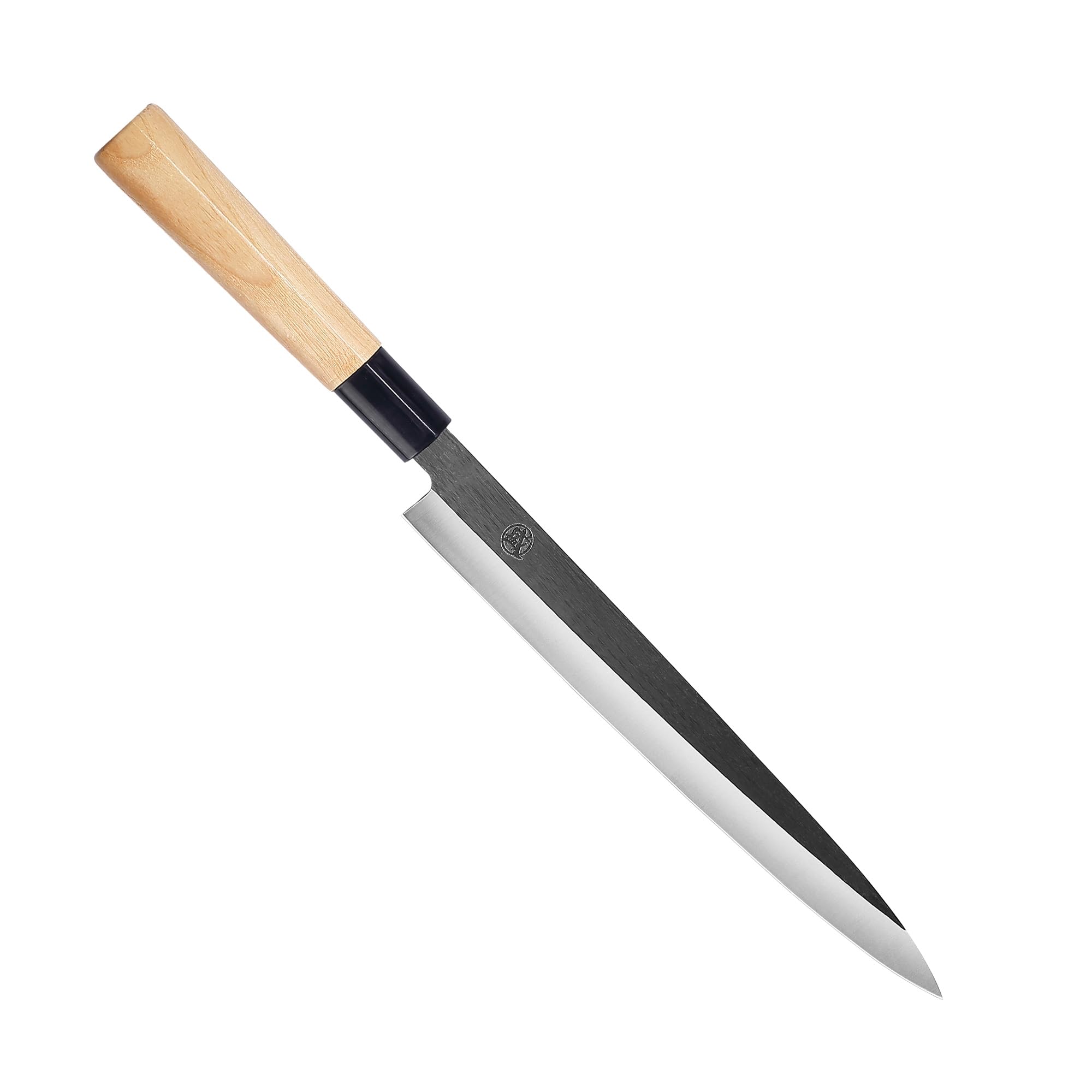
Featherweight blade with a hand-finished ash handle that grips even when wet
At 5.92 ounces this is the lightest forged knife in the group, and that lightness defines how it feels. The 15° single-bevel edge keeps friction low so slices pass through rather than tearing, and the textured blade surface helps delicate fish release instead of sticking. A 10-inch blade inside a 15.35-inch overall length gives you a long, controlled draw on a salmon fillet without a heavy wrist load.
The handle is the standout detail. It is hand-finished from Manchurian ash wood, an oval shape that contours to your palm and keeps its grip when wet, with a dense grain said to stand up to knife marks. Cooks who like a warm, natural handle respond to it immediately — the polished wood and long thin blade are exactly the pairing they describe as a joy to cut fish with.
Now the honest part. Quality and sharpness land as mixed across the range: some knives arrive needling-sharp, others show an unevenly ground edge or need extra honing to reach a true razor finish. A rough, splinter-prone handle has shown up on the odd unit, though the seller has replaced those and the replacements came back right. The ash handle and light blade are lovely — just inspect the edge when it arrives.
What stands out
- 5.92-ounce forged blade stays light for long slicing sessions
- Manchurian ash handle grips well when wet and holds a warm natural feel
- 15° single bevel with a concave backside releases fish cleanly
- Sellers have stood behind units with a rough edge or splintering handle
Where it wobbles
- Edge sharpness from the start varies — some need honing before first use
- Occasional rough or splinter-prone handle finish on some units
- Light weight means less momentum if you are used to a heavier blade
Worth grabbing if: a warm wooden handle and light weight top your list, and you do not mind honing a fresh edge.
Pass it over: if you want a guaranteed razor edge straight from the box.
6. KEEMAKE 11.5 inch Sashimi Knife, Japanese VG10 Single Bevel

An 11.5-inch VG-10 blade for cooks ready to earn the edge on the stones
The headline here is steel and length together: an 11.5-inch blade forged from VG-10 high-carbon stainless and vacuum heat-treated to a stated 58+ Rockwell hardness. VG-10 is a well-known Japanese cutlery steel, and that hardness figure points to real edge retention. The craftsman ground the edge to 12-15 degrees and hand-sharpened it, and the single-bevel geometry on an 18.16-inch overall knife lets a long pull travel the full length of a fillet.
Owners who take sharpening seriously find substance in it. The steel is hard — one buyer spent several hours reworking the blade on oil stones and still was not finished, a clear sign of dense steel rather than soft, quick-grinding metal. Sliced cured salmon held its edge well on a polymer board, and the construction feels durable in the hand. In short, this is dense VG-10 that rewards time on the stones.
The uncomfortable caveat is that quality is genuinely divided across units, and one specific problem stands out. A yanagiba needs a single flat front bevel and a concave back face, and at least one buyer reports a manufacturer second bevel ground so deep it could not be corrected — a fatal flaw for the knife’s purpose. Steel provenance is another open question some cooks raise. If you buy, inspect the bevel carefully on arrival.
If the grind is right: you get a long, hard VG-10 single bevel that slices cured and raw fish cleanly and holds up on a board.
The risk to know: second-bevel grinding errors exist on some units, and that is not a flaw you can sharpen your way out of.
Pick it if: you want a long VG-10 blade, sharpen confidently on stones, and will verify the bevel the day it lands.
Steer clear: if you want a guaranteed single flat bevel without inspection.
7. Kai Sekimagoroku Takuso All Stainless Yanagi, 240 mm

The all-stainless yanagiba you can rinse and rack without a second thought
The spec to notice is the one no other knife here carries: this one is dishwasher safe. An all-stainless body — blade of molybdenum vanadium stainless set into a stainless handle — means no wood to swell, no lacquer to chip, and no careful towel-drying ritual after a fish session. At 6.6 ounces and 13.6 inches overall with a 9.4-inch blade, it is a working knife for people who value low fuss over traditional materials.
The length and edge are described as fully adequate for slicing sashimi, and maintenance is repeatedly called easy. For a home cook who wants a real single-bevel slice without hand-drying after every use, that combination is a quiet win.
One thing worth knowing: this is a low-maintenance stainless workhorse, not a carbon-steel showpiece. It will not develop the patina or the high-end edge feel that a harder carbon blade can, and if your enjoyment comes from traditional materials you will find it plain. But if you want a sharp single-bevel slicer that tolerates the dishwasher, it delivers.
Reach for it: if you want a genuine single-bevel slicer that tolerates the dishwasher and low-effort maintenance.
Skip it: if you are chasing the character and edge of traditional carbon steel.
8. Masahiro Fukui Stainless Steel Yanagi Blade 270 mm

A 270 mm blade that holds its edge through a full day of fish
Hardness and length are the pitch, and both hold up. Masahiro forges this from its own MBS-26 stainless steel — a mix of 0.9% carbon, 13% chrome, plus molybdenum and vanadium — heat-treated to a Rockwell hardness of HRc58-59. That spec is about holding an edge under load, and it is exactly what one cook found after three months at a busy sushi bar: the blade kept cutting through daily fish service without falling off. The 270 mm blade gives you a full-length pull on larger fillets.
Owners describe the quality and sharpness favorably, and it earns its keep for anyone slicing fish several times a day. The weight sits at 170 grams, and the base measures around 0.1 inches thick, so it is a thinner profile than a traditional heavy yanagi — a lighter, nimble feel for some, and less natural heft for others. The stainless handle runs smooth, which a couple of cooks found too slick to hold confidently with wet hands.
The main trade-off is that this is a specialized blade that rewards technique. One reviewer noted it is thinner and lighter than a traditional yanagi and needed more effort for the cut, while another wished for a full tang rather than the semi-tang on this knife. If you are a careful home cook or a pro who knows the technique, these are minor; if you want a heavy, forgiving chopper, it will feel light.
The retention play: MBS-26 stainless at HRc58-59 is built to stay sharp through steady fish prep, not just one weekend cook.
What to prep for: a thin 170 g blade and a smooth stainless handle — comfortable for some, too slick for others with wet hands.
It suits: the home cook or pro slicing fish several times a day who values edge retention and a full 270 mm reach.
Look elsewhere: if you want a heavy, traditional-feeling yanagi or a handle you can grip hard when wet.
9. FINDKING Prestige Series Yanagiba Knife

The one that arrives in a wooden box with a saya, ready to hand over
This is the pick that solves gifting and storage at the same time. A 10.5-inch single-bevel blade in Japanese SKD11 alloy steel arrives with a fitted walnut saya cover lined in felt, packed in a wooden presentation box with inner cushioning. The ebony and sapele mahogany octagonal handle gives a stable grip for long slicing motions, and the Damascus pattern on the blade gives the knife a look that owners call a work of art.
The craft shows up in the cut, too. Cooks describe it slicing through fish cleanly, with the octagonal handle holding steady during repeated slices, and the edge retention of the SKD11 steel giving it real kitchen work beyond sashimi — the maker notes it handles delicate boneless proteins and general prep. For someone building a dedicated sushi knife collection or buying a gift that looks the part, the whole package feels considered.
The knocks come down to size and upkeep. This is a heavy knife that runs longer than many home cooks expect, and a couple of owners found it too long for everyday kitchen work. It also asks for proper hand-sharpening skill — if you cannot maintain a single-bevel edge, the sharpness will not stay, and one buyer felt the durability did not hold up between uses. It is a knife for someone willing to hand-sharpen a single bevel.
Why it earns the gift spot
- Walnut saya cover and wooden presentation box make it a ready-to-give package
- SKD11 Damascus steel with a single-bevel edge for clean sashimi cuts
- Ebony and sapele mahogany octagonal handle stays steady through long slicing
- Sharp from the start and looks the part on a display shelf
The honest catches
- 10.5-inch blade and heavy build can feel too long for small home kitchens
- Needs competent single-bevel hand sharpening to keep its edge
- Some owners found durability across uses less than expected
Buy it for: gifting a serious sushi cook or adding a presentation-grade blade with its own saya and box to a collection.
skip it if: your kitchen is tight or you are not ready to learn single-bevel sharpening.
Know the Specs
Single bevel vs double bevel
A single-bevel edge means one face is ground sharp and the other is flat or hollowed, so the knife cuts on a pull stroke and the slice releases cleanly. A double-bevel knife is ground on both sides and pushes through food symmetrically. For sashimi, the single bevel is the whole point — it lets you control thinness and avoid tearing the fish. When a listing shows two matching grinds, it is a double-bevel blade and will not give you the same finish.
Rockwell hardness (HRC)
HRC is a scale that measures how hard a steel is. Higher numbers mean the edge resists wear longer but can be more brittle and harder to sharpen; lower numbers mean the blade is softer, sharpens easily, and dulls faster. Kitchen knives commonly sit in the high 50s to low 60s, which is a good working range. If you see a hardness in that band, expect decent edge retention with maintenance.
Blade length and pull-cut control
Blade length decides how far you can carry a single cut. A shorter blade in the 8-inch range is fine for home portions and small fillets, while a 10- or 12-inch blade travels the whole length of a larger fish so you are not stopping and starting. Match the length to your fish and your board — a very long blade in a short kitchen becomes unwieldy.
Handle materials and wet grip
Fish prep means damp hands, so handle material is a real decision. Wood such as ash, ebony, or rosewood gives a warm natural feel but needs care to avoid swelling. Stainless and synthetic handles are low-maintenance and rinse clean, though a very smooth surface can slip. Octagonal or oval shapes tend to give a more secure hold during long slicing.
Common Questions
What is a yanagiba and why does it matter for sushi?
Can I use a yanagiba for vegetables or meat?
Left-handed or right-handed — does the bevel matter?
How do I sharpen a single-bevel yanagiba?
How long does the edge last before I need to sharpen?
Should I put a yanagiba in the dishwasher?
What size yanagiba should a home cook buy?
Do I need a wooden saya or edge guard?
Is higher HRC always better?
Will a high-carbon blade rust if I leave it wet?
The Bottom Line
The honest winner for most home cooks is the Kai Wasabi 8.25” Yanagiba, because it puts a genuine single-bevel edge in your hand at a price that lets you learn on it, and it stays light enough to pull through a whole fillet. If you want a finer edge and long blade, the HOSHANHO 10-incher brings the 12° bevel and 62 HRC hardness. And if your kitchen runs on dishwasher convenience, the Kai Sekimagoroku Takuso is the all-stainless pick — and the whole set is worth a look, since these knives have earned a steady crowd of happy owners.
How we choose
We do not accept paid placement. Every pick is matched to a real buyer and a real use-case; we do not hands-on test units.
Sources
Specifications: manufacturer listings and product documentation. Review insights: verified customer reviews, as of October 2026. Pricing: not shown on this page (it changes often); check the current price via the retailer link.
As an Amazon Associate, Home Digitized earns from qualifying purchases. This does not affect which products we feature.