
Specs are compiled from manufacturer listings and verified buyer reviews and can change over time — please confirm the key details on the product page before buying.
Forward facing sonar (FFS) is the live, real-time scan that shows you where fish are before they bite — it sweeps a cone of sound ahead of your boat or under your hole and paints a moving picture on the screen. If you want the short answer: the Garmin LiveScope Plus (GLS 10 + LVS34) is the strongest all-rounder for boat anglers, the Lowrance Eagle Eye 9 is the best entry point into live sonar, the Garmin Panoptix LiveScope Ice Kit is the purpose-built ice setup, and the ECHOMAP Ultra 2 10″ LiveScope Plus Bundle is the premium all-in-one for someone who wants everything in one box.
This guide is built by comparing the manufacturers’ published specifications and the patterns across verified customer reviews, so you get each pick’s real strengths and trade-offs instead of marketing spin.
Every pick here is a genuine forward-facing system — no traditional down-imaging-only units sneaking in — so you can match the right one to your boat, your hole, or your budget. This is the filtered shortlist of forward facing sonar fish finders.
Top Picks
How To Choose The Best Forward Facing Sonar Fish Finders
Forward-facing sonar works on one simple idea: instead of aiming straight down and seeing only what is directly beneath you, the transducer sends sound out ahead of the boat or under the ice, in a cone that keeps sweeping. The screen shows fish, baitfish and structure in motion, so you can tell whether that mark is a fish that just turned toward your lure or one drifting away. That live view is what separates it from a standard echo sounder, which only ever shows you a scrolling history of what has already passed under you.
Transducer And Black Box: The Two Halves Of A System
The transducer is the part that touches the water and creates the sonar picture. The black box is the small module that turns those echoes into an image your screen can display. Some systems — like the Garmin LiveScope Plus — use a separate black box, which makes them easy to upgrade later without replacing the transducer. Others — like the Lowrance Eagle Eye 9 — skip the box entirely and plug the transducer straight into the display, which simplifies installation on a smaller boat.
Live Forward Vs Live Down: Which Mode You Need
Live forward points the beam ahead of your position, which is the mode boat anglers use most for watching a fish approach a lure. Live down points the beam straight down through a hole in the ice, so you can watch your bait and the fish around it from above. A system that supports both modes — or all three, if you add perspective — covers more fishing situations than one locked to a single view.
Screen Size And Sunlight Readability
A bigger display is easier to read when you are standing on a rocking boat, but size alone is not the whole story. Brightness and a matte, sunlight-readable finish matter just as much, because a washed-out screen in direct sun makes even a sharp sound image hard to interpret. If you fish from a small boat, a 9-inch panel often strikes the best balance of visibility and deck space.
Side-by-Side Comparison
| Model | Best For | Max Depth | Display Size | Item Weight | Amazon |
|---|---|---|---|---|---|
| Garmin LiveScope Plus (GLS 10 + LVS34)★ Best Overall | Best all-round boat setup | — | 10.1 inches | 10.6 pounds | Amazon |
| Lowrance Eagle Eye 9 | Best first live sonar | 500 feet | 9 inches | 2 pounds | Amazon |
| Garmin Panoptix LiveScope Ice Kit | Best for ice fishing | 200 feet | — | — | Amazon |
| ECHOMAP Ultra 2 10″ LiveScope Plus Bundle | Best all-in-one chart plotter bundle | — | 10 inches | 17 pounds | Amazon |
Detailed Reviews
1. LiveScope™ Plus System with GLS 10™ and LVS34 Transducer
Our pick — 4.5+★ from 200+ verified ratings; the strongest balance of quality and price.
The boat angler’s benchmark system, and the one the rest of this list quietly measures itself against.
This is the pick for the open-water angler who wants the clearest live picture of fish reacting to a lure and is willing to build a proper setup around it. The LVS34 transducer pairs with the GLS 10 black box to deliver sharp live sonar images with reduced noise and fewer artifacts (stray echoes that smear the picture), and it supports Forward, Down and Perspective mode with all necessary mounts in the box. That three-mode flexibility — watch ahead, watch straight down, or look from a different angle — is what makes it the most versatile system here rather than a single-view tool.
The standout number is the display size it drives: it runs on a 10.1-inch panel, which gives you more of the water in view than the 9-inch Lowrance Eagle Eye 9. Weight is the honest trade-off — at 10.6 pounds the full system is far heavier and bulkier than the 2-pound Eagle Eye 9, so it is a permanent boat install rather than something you toss in a bucket. The box also lists a compact 5.9″L x 2.6″W x 9.6″H footprint for the head unit itself, which keeps the transom side tidy.
What wins owners over is the quality of the picture and how reliably it works, plus its flexibility when the mount is set up well. Buyers report “Worked flawlessly for 11 months, then failed to stay calibrated; manual view switching is difficult during fishing/tournaments.” — the recurring gripe is that manual view switching gets fiddly when you are trying to keep the boat on a mark, so spend the break-in time learning the interface. The upgrade path is genuine, though: the LVS34 also works with an existing LiveScope GLS 10 black box, so there is easy upgrade room if you already run Garmin hardware.
What You Gain
- Sharp live sonar with reduced noise and fewer artifacts
- Forward, Down and Perspective modes in one transducer
- All necessary mounts included in the box
- Vivid color palettes for detail and clarity
- New LVS34 works with existing GLS 10 black box for easy upgrade
The Trade-Off
- 10.6 pounds — heavy as a permanent boat install
- Needs a compatible ECHOMAP or GPSMAP unit, sold separately
- Manual view switching gets fiddly under pressure
The verdict: The system for the open-water angler who wants the clearest live read of fish approaching a lure and a real upgrade path.
Consider the Eagle Eye 9 instead if: you want a fraction of this weight and a simpler no-black-box install.
2. Lowrance Eagle Eye 9 Live Sonar Fish Finder
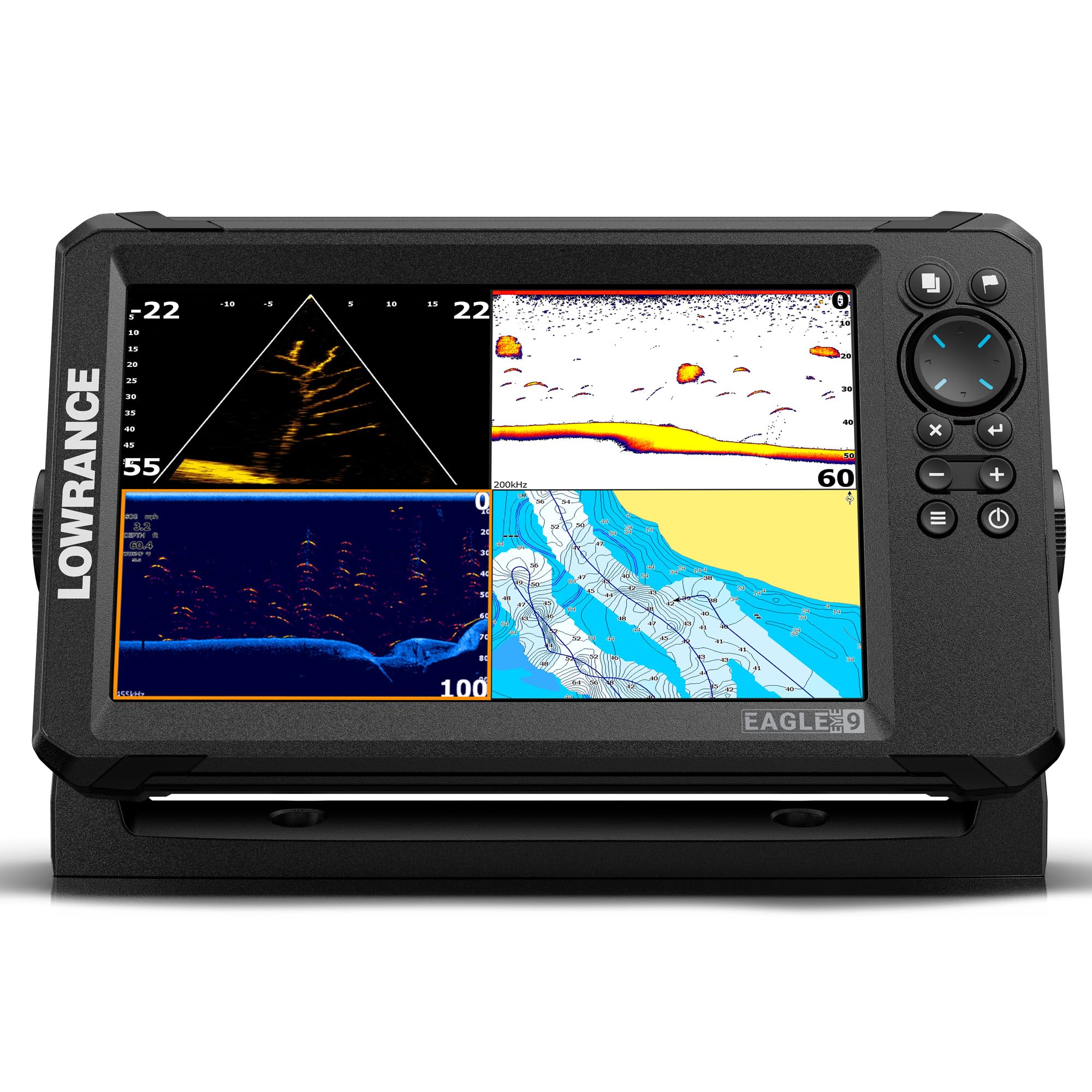
Two pounds, one cable, no black box — the entry point that makes live sonar feel simple.
The angler who gets the most from this one is the first-time live-sonar buyer, or the ice angler who moves from hole to hole all day. The whole story is in the install: the transducer connects directly to the 9-inch IPS display with no separate sonar module, which is why the system weighs just 2 pounds. Compare that with the 10.6-pound LiveScope Plus and the point is obvious — this is the one you can carry, reposition and re-rig without breaking a sweat.
The 500-foot maximum measuring depth is the deepest figure on this list and it out-runs the Garmin Panoptix LiveScope Ice Kit’s 200 feet by a wide margin. In practice that means it reads deep structure and marks fish far below — good news if you fish ledges or drop-offs. The included transducer covers Live Forward, Live Down, CHIRP sonar and DownScan Imaging with FishReveal, and FishReveal merges CHIRP fish targets with DownScan detail so fish stand out against structure instead of blending into it. C-MAP charts cover more than 17,000 U.S. lakes plus Genesis Live mapping for inland fishing.
Where owners land is on value and function first and foremost — the recurring praise is how much you get for the entry-level outlay, and what they tend to flag is the live view. Owners mention “It works. used live action to fish for flathead cats in 40ft water with live Bream for bait.” The honest note is that some find the live performance less detailed than the premium Garmin systems, and the mount-to-trolling-motor setup can be fussy when wind pushes the boat — several owners buy a separate pole and run it off the side instead. Snapshot: a straightforward screen with clear daylight readability and an inland chart package that some treat as a bonus rather than the main event.
The picture: Live Forward and Live Down views show fish movement and how they react to your lure, with FishReveal adding DownScan detail so fish stand out from structure.
On the mount: the trolling-motor connection is the weak spot when wind is blowing; a side pole solves it and many owners go that route.
Get this if: you want a light, self-contained live system for a smaller boat or daily hole hopping.
Set your expectations: the live detail and the trolling-motor mount are where it shows its entry-level roots.
3. Garmin Panoptix LiveScope Ice Fishing Kit

Purpose-built for the hard-water angler who wants to drill fewer holes and fish the right ones.
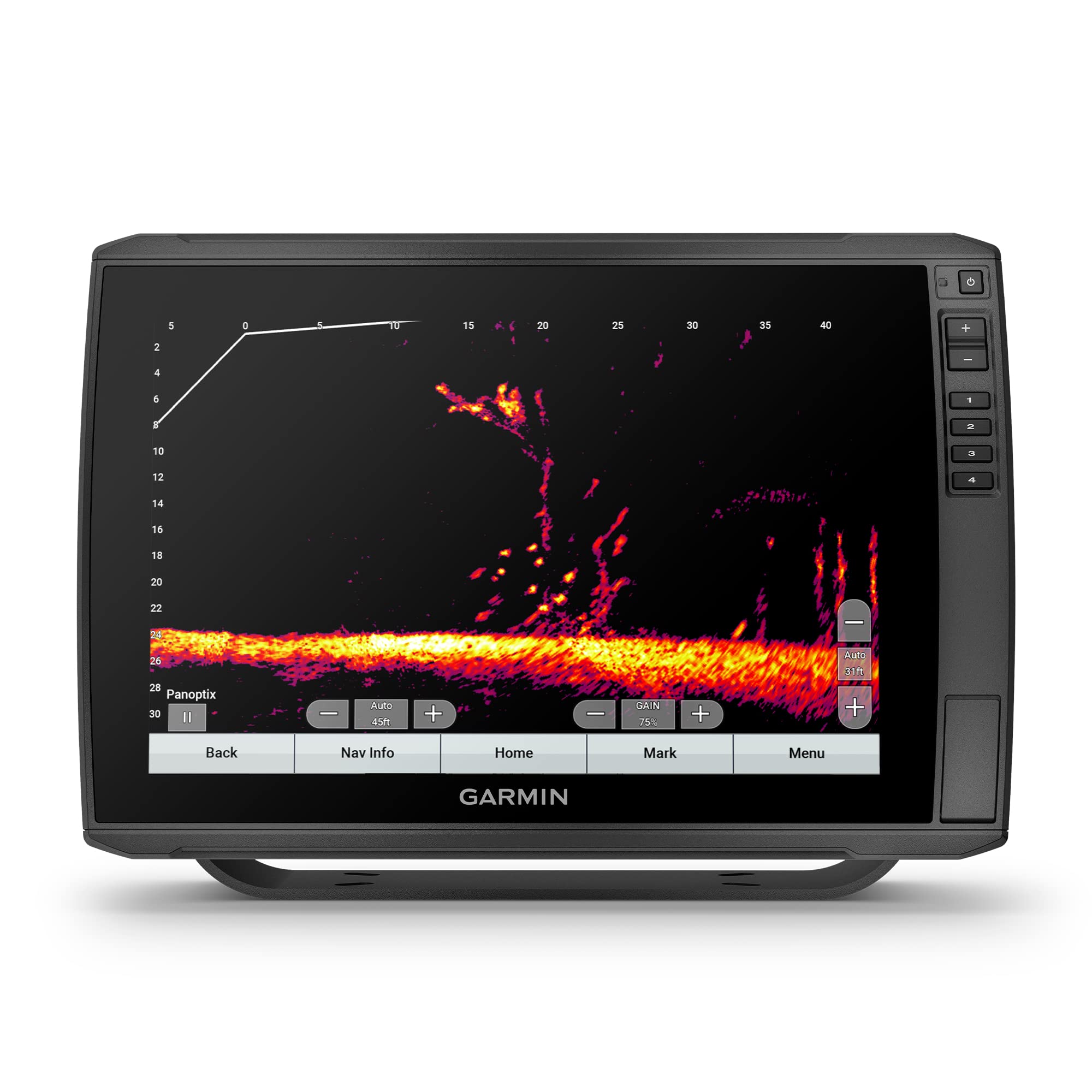
Pair this with a compatible ECHOMAP UHD unit and you get live, real-time scanning sonar that sees up to 200 feet in any direction — the spec that matters most for ice fishing, where you are standing in one spot and want to know what is around you before you commit to a hole. The transducer runs two modes, LiveScope Forward and LiveScope Down, so you can point the beam ahead to find a school and then drop it down to watch the fish around your bait.
Everything about the kit is aimed at being set up on the ice fast. The rugged portable carrying case holds your ECHOMAP UHD unit plus all included parts, and the accessories cover a swivel pole mount for the transducer, a foam float and cable grommet, a 12Ah battery, a charger, a power cable and a transducer adapter cable. The whole package arrives essentially pre-built — the box includes the GLS 10 and the pole — so you mostly connect the battery, attach your head unit and mount the transducer. Anglers fishing crappie from the boat side found it worked the moment they added their Garmin 93sv.
The running theme among owners is how it changes where you drill. Customers note “Kit includes GLS10 and pole. Issue: battery died after ~8 hours; consider buying a new battery with this kit.” The honest recurring note is the 12Ah battery — a handful of owners found it ran short of a long day and swapped it out. A kit that is this portable and this complete is worth the extra battery on your list. The transducer also fits a range of Garmin sounder units, so if you already own a compatible ECHOMAP, this is the piece that turns it into a live sonar rig.
What it does: sees up to 200 feet in any direction with both Forward and Down modes, so you can locate a school and know where to drill next.
Worth knowing: the 12Ah battery is the commonly cited weak link and a lithium replacement is the usual fix; the kit also ships without a monitor.
Built for: the ice angler who wants a grab-and-go live sonar kit and already runs a compatible Garmin ECHOMAP.
Budget for: a spare battery and a separate head unit, since neither is the strong suit from the start.
4. ECHOMAP Ultra 2 10″ LiveScope Plus Bundle
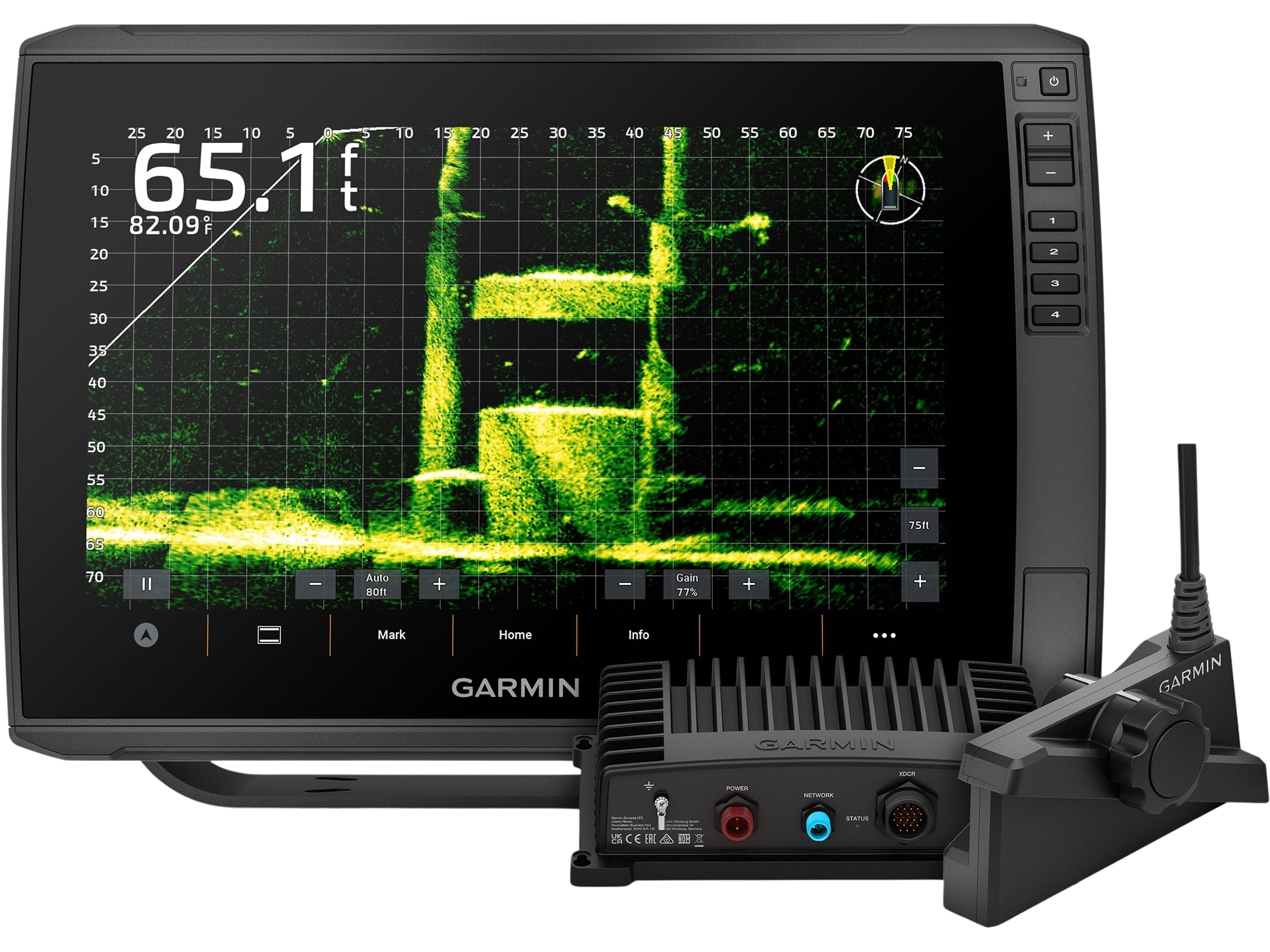
The all-in-one for the angler who wants the display, the mapping and the live sonar in one box.
If you don’t already own a chart plotter, this bundle is the one-stop route into live sonar: it marries the ECHOMAP Ultra 2 head unit with LiveScope Plus and the mounting hardware in a single package. The display is a crisp, sunlight-readable touchscreen with vivid, high-contrast color palettes — which matters when you’re trying to read a live return with the sun at your back — and it ships with built-in Garmin Navionics+ mapping plus a 1-year subscription for daily updates. It also shares information wirelessly with other Ultra 2 or UHD2 fish finder/chartplotters on your boat.
The screen is 10 inches, the same size as the LiveScope Plus system’s 10.1-inch display, so you get the same forward-facing perspective at the helm. At 17 pounds this is the heaviest unit on the list — it stays bolted to the boat. The all-inclusive nature is the appeal: no hunting down a separate display, no fussing with a black box on its own. For a buyer who wants a complete boat electronics upgrade, that convenience is the whole point.
What sells the bundle to owners is how completely it changes a boat setup, and how much they want to add more compatible gear once they’re in the Garmin ecosystem. Two recurring gripes stand out and both are worth knowing before you click. Reviewers point out the listing says a 12-inch screen but ships a 10-inch one — the second complaint is about units arriving as old stock with out-of-date software. Neither is about performance, but the listing discrepancy has been flagged repeatedly, so read the size carefully before ordering.
The Case For It
- Crisp, sunlight-readable touchscreen with vivid high-contrast color
- Built-in Garmin Navionics+ mapping with a 1-year daily-update subscription
- Wireless sharing with other Ultra 2 or UHD2 units
- Everything in one box — display, LiveScope Plus and hardware
What to Watch
- Listing mismatch: advertised as 12-inch, ships a 10-inch display
- Some units arrive as older stock with out-of-date software
- 17 pounds — permanent boat install only
The pick for: the boater building a complete electronics suite who wants a chart plotter and LiveScope Plus together.
Eyes open on: the screen-size listing — check it is the 10-inch unit you actually want.
Know the Specs
Live Forward and Live Down Modes
Live Forward points the sonar beam out ahead of your position so you can watch a fish turn toward your bait — the mode most boat anglers keep on all day. Live Down points the beam straight down, which is what you use through an ice hole to watch your bait and the fish around it. Some units, like the Garmin systems here, also add a perspective view for a third angle. More modes means more fishing situations covered.
Maximum Measuring Depth
This is the deepest the unit can reliably mark a target, in feet. The Lowrance Eagle Eye 9 lists 500 feet and the Garmin Panoptix LiveScope Ice Kit lists 200 feet. Deeper doesn’t automatically mean better — for ice fishing you rarely need to see that far, but for open-water ledge and drop-off fishing a deeper rating gives you more reach. Match the depth figure to where you actually fish.
Black Box vs Direct Connection
A black box is a small module that converts transducer echoes into a picture your screen can read. Systems like the Garmin LiveScope Plus use one, which makes them easy to upgrade later by swapping just the transducer. Others, like the Lowrance Eagle Eye 9, connect the transducer straight to the display and skip the box entirely — a simpler install and one less component in your setup.
What’s in the Box Matters
These kits vary widely in completeness. The Garmin Ice Kit includes the transducer, pole mount, float, grommet, a battery and a charger. The LiveScope Plus system includes the mounts but expects you to supply a compatible ECHOMAP or GPSMAP unit. The Lowrance Eagle Eye 9 includes the display and live transducer. Know what you’re still on the hook for before you order — especially the head unit.
Common Questions
Do I need to already own a chart plotter to use forward facing sonar?
What is the difference between Live Forward and Live Down modes?
How deep can these units actually see?
Does the Lowrance Eagle Eye 9 need a black box to work?
Will the Garmin Panoptix LiveScope Ice Kit work with my existing ECHOMAP unit?
Can I upgrade the Garmin LiveScope Plus later without replacing everything?
What battery does the Garmin Ice Kit use and will it last a full day?
Is the ECHOMAP Ultra 2 bundle a 10-inch or a 12-inch screen?
Which forward facing sonar is best for ice fishing specifically?
Do models with a black box perform better than ones without?
The Bottom Line
The strongest forward-facing sonar for most boat anglers is the Garmin LiveScope Plus (GLS 10 + LVS34), because it combines the sharpest live picture with genuine upgrade room and Forward, Down and Perspective modes. If you want to step into live sonar with a lighter, self-contained unit, the Lowrance Eagle Eye 9 gets you there with a 500-foot depth rating and no black box. And if you spend your winter on the ice, the Garmin Panoptix LiveScope Ice Kit is the grab-and-go answer — just plan on a spare battery. The ECHOMAP Ultra 2 bundle rounds it out for anyone who wants the screen and live sonar together in one purchase. Whichever you choose, the payoff is the same: watching fish react to your lure in real time instead of guessing at a scrolling history.
How we choose
We do not accept paid placement. Every pick is matched to a real buyer and a real use-case; we do not hands-on test units.
Sources
Specifications: manufacturer listings and product documentation. Review insights: verified customer reviews, as of October 2026. Pricing: not shown on this page (it changes often); check the current price via the retailer link.
As an Amazon Associate, Home Digitized earns from qualifying purchases. This does not affect which products we feature.