
Specs are compiled from manufacturer listings and verified buyer reviews and can change over time — please confirm the key details on the product page before buying.
If your car cannot reach your outlet, you have a reach problem, not a charger problem — and the fastest, cheapest fix is a cord built for the job. Standard household extension cords cannot carry the 240-volt surge a Level 2 setup pushes through, which is precisely why the picks below all use heavy-gauge wiring and a connector that matches your outlet. This guide ranks nine cords for EV charging, explains the amperage and connector math you actually need to check, and tells you which one fits a garage, a driveway, or a campsite.
This guide is built by comparing the manufacturers’ published specifications and the patterns across verified customer reviews, so you get each pick’s real strengths and trade-offs instead of marketing spin.
Every cord here runs on 125/250 volts, uses flame-retardant insulation, and matches one specific outlet type you need to verify before you buy. Read on for the shortlist that turns your driveway into a charging bay with the best extension cords for EV charging.
Top Picks
How To Choose The Best Extension Cords for EV Charging
Charging a car is different from running a lawnmower. Your car draws high current for hours at a time, so the cord has to move that load without warming up. That single fact drives every decision below.
Match the plug before anything else
Your outlet shape decides which cord works. A NEMA 14-50 outlet is the round four-prong socket common for 50-amp RV and EV hookups, and a NEMA 14-30 is the smaller four-prong socket you will find behind an electric dryer. A J1772 cable is different again — it extends the charging cable itself, plugging into the handle rather than the wall. Buying the wrong one means the cord simply will not fit.
Amperage is your safety ceiling
A 50-amp cord carries more current than a 40-amp or 30-amp model. More importantly, a cord rated at 50 amps is typically built to run continuously at a lower draw without overheating, which is exactly what overnight charging demands. If your charger pulls 32 amps, a 50-amp cord gives you headroom; a 30-amp cord does not.
Wire gauge controls the heat
Gauge, written as AWG, measures wire thickness — and lower numbers mean thicker wire. A 6-gauge conductor handles more current with less resistance than a 10-gauge one. Thicker wire resists voltage drop, so your charger keeps delivering its full rate instead of easing off as the cord warms.
Side-by-Side Comparison
| Model | Best For | Amperage | Length | Connector Type | Amazon |
|---|---|---|---|---|---|
| VEVOR 25 FT 50Amp RV Extension Cord★ Best Overall | Overnight garage charging | 50 A | 25 ft | NEMA 14-50P to 14-50R | Amazon |
| PlugSaf 15 FT 50 Amp RV/EV Extension CordBest Value | Short reach to a pedestal | 50 A | 15 ft | NEMA 14-50P to 14-50R | Amazon |
| POWGRN NEMA 14-50P to 14-50R 25 FTTop Performer | Driveway and RV pad | 50 A | 25 ft | NEMA 14-50P to 14-50R | Amazon |
| 30-Amp 4-Prong Dryer EV Extension Cord | Charging off a dryer outlet | 30 A | 25 ft | NEMA 14-30P to 14-30R | Amazon |
| SEGUMA J1772 EV Charger Extension Cable, 40A | Extending a J1772 charger cable | 40 A | 21 ft | J1772 to J1772 | Amazon |
| for Tesla Extension Cord 240V, 50A NACS | Tesla home charging reach | 50 A | 21 ft | NACS (Tesla) | Amazon |
| SEGUMA EV Charger Extension Cable, 50A UL Listed | Long J1772 runs | 50 A | 20 ft | J1772 to J1772 | Amazon |
| Inteset 21ft 40amp J1772 EV Extension Cord | Cold-climate flexibility | 40 A | 21 ft | J1772 to J1772 | Amazon |
| Nilight 50 Amp 50FT RV EV Extension Cord | Maximum distance | 50 A | 50 ft | NEMA 14-50P to 14-50R | Amazon |
Detailed Reviews
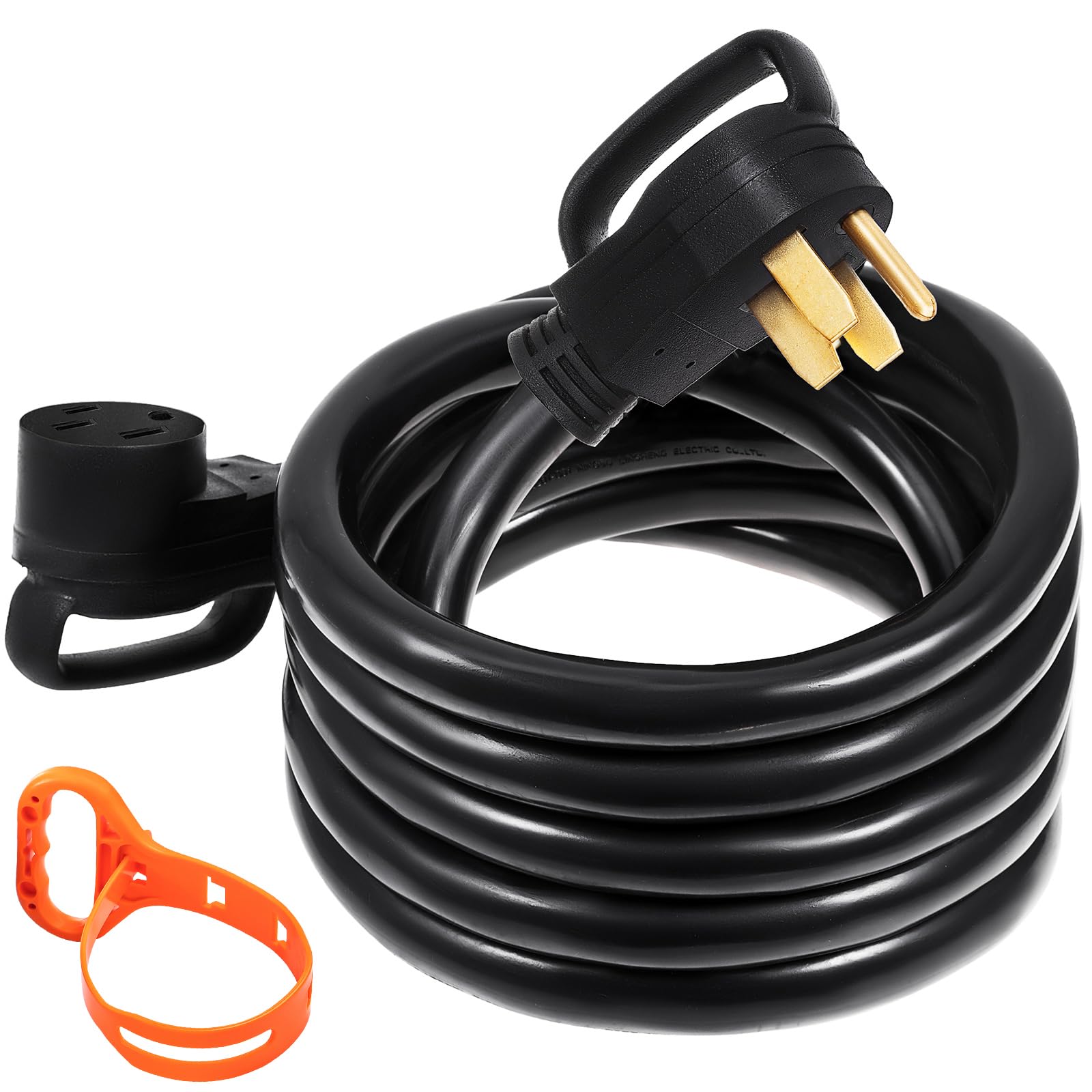
1. VEVOR 25 FT 50Amp RV Extension Cord NEMA N14-50P to N14-50R
Our pick — 4.5+★ from 450+ verified ratings; the strongest balance of quality and price.
Six-gauge copper that never even warms up while your car sips 32 amps overnight.
Your garage outlet is on the wall, your car is in the driveway, and the charging cable is a few feet too short. The VEVOR fixes that with 25 feet of reach from a NEMA 14-50P male plug to a NEMA 14-50R female socket (the standard four-prong 240-volt shape that matches most home charging outlets). It carries a 50-amp rating and a 6-gauge STW jacket (a thick outdoor-rated rubber coating) over pure copper, so it has real headroom for a 40-amp continuous draw — enough to charge overnight without the cord running warm.
Two design details earn their keep in daily use. The threaded locking ring screws the connection shut so rain cannot reach the contacts, and the pro-style handle grip lets you pull a stiff, cold plug without yanking on the cable itself. The whole run measures 300 inches and weighs 19.1 pounds, which is the trade-off — this is not a cord you toss in the trunk for a road trip. It is garage equipment.
Buyers keep coming back to the build: 27 owners single out quality, and heavy-duty construction is the second-most-praised trait at 11 mentions. Weight is the most-debated point, with 7 owners split on it — read that as sturdy enough to trust, heavy enough to plan around. One buyer reports: “Used as continuous extension for Tesla Mobile Connector (32A draw) on 14-50 outlet; 50A cord rated for 40A continuous, no warmth felt at 32A.” It holds 4.5+ stars across 450+ ratings.
The case for it
- 6-gauge pure copper with a 50-amp rating leaves genuine headroom for a 32-amp continuous draw
- Threaded locking ring seals the plug connection against rain during outdoor charging
- Handle grips on both ends make plugging and unplugging safe without stressing the cable jacket
- 25 feet reaches a driveway park spot from a wall-mounted outlet
What to expect
- At 19.1 pounds it stays put — coiling it takes a moment, and one buyer found the box-fresh cable stiff at first
- The included carry strap runs small for the full coil
Reach for this if: your outlet and your parking spot are on the same property and you want one cord that handles ev charging plus camper power.
Think twice if: you need a cable light enough to travel with you on every trip.
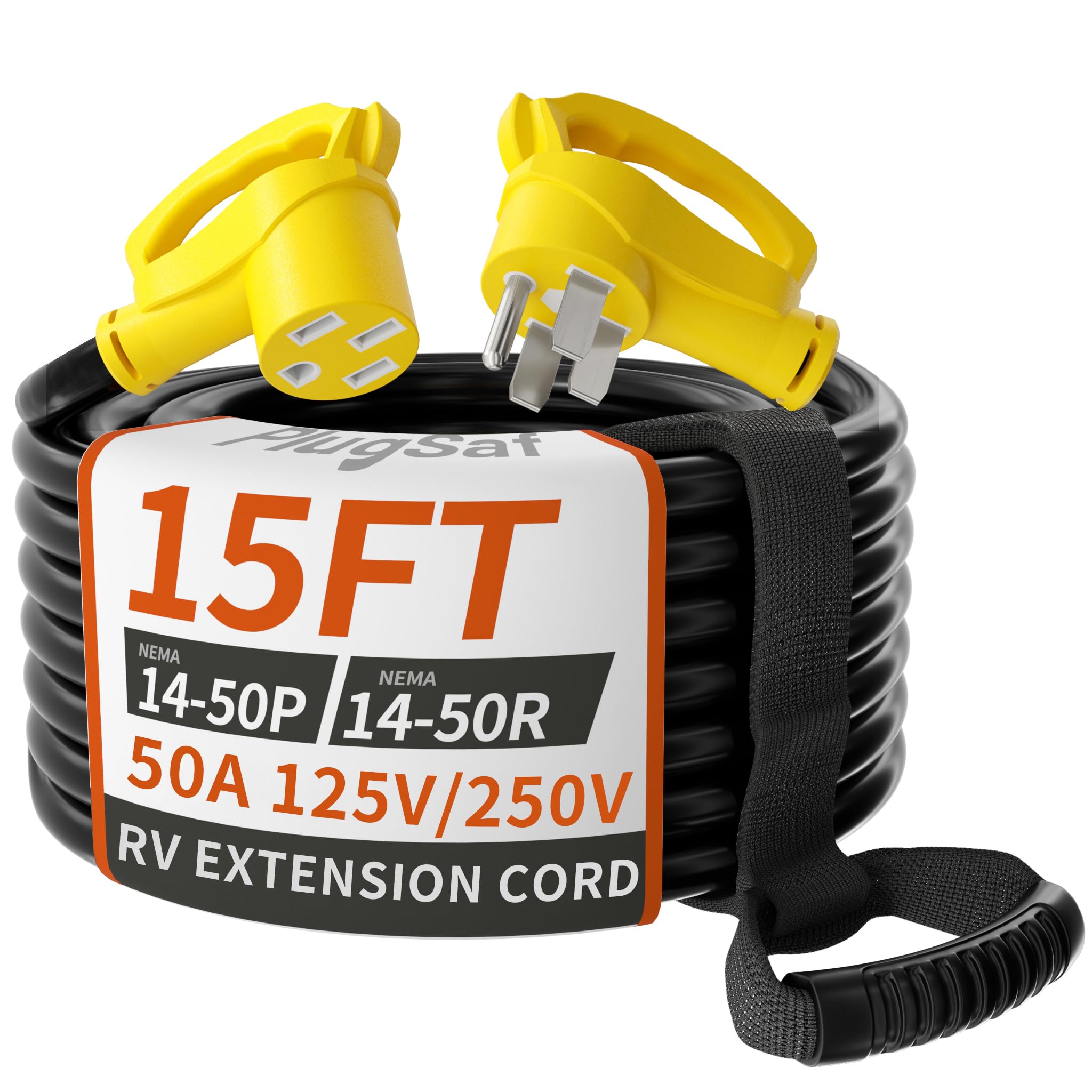
2. PlugSaf 15 FT 50 Amp RV/EV Extension Cord Outdoor
The short cord that ends the daily dance of shuffling cars to reach the plug.
If your outlet is close, 15 feet is all you need — and it saves you weight. The POWGRN above spans 300 inches while this one spans 180 inches, so if your gap is smaller than about two car lengths, you skip the bulk without losing anything that matters. The PlugSaf runs 50 amps at 125/250 volts through a pair of NEMA 14-50 connectors (the same four-prong shape used on most home Level 2 hookups) and supports the charging needs of a Tesla Model 3, S, X or Y.
The upgraded build is why it survives outdoors. Pure copper sits under nickel plating, and that coating resists corrosion and wear across many plug-in cycles. Its IP65 rating (a dust-tight, water-spray-resistant seal) means it shrugs off dust and rain, and the jacket stays usable down to -40°F, so a cord left plugged in through a cold snap still coils when you need it. At 3.97 kg it is noticeably lighter than the 5.85 kg POWGRN.
Quality is the headline trait owners praise most, named 66 times, with construction a distant second at 23. Buyers report: “Well made wire and terminations. Used to charge my Tesla successfully.”
Where it lands: The 15-foot length is the point, not a compromise — it covers a garage, a short driveway, or a pedestal that sits close to your trailer.
One honest note: If your outlet is on the far side of a long driveway, look at the 25-foot POWGRN or the 50-foot Nilight instead — this one simply will not span that distance.
Best fit: a plugged-in-forever garage cord for someone who wants solid connections without the bulk of a 25-footer.
Look elsewhere if: your parking spot sits more than a couple of car lengths from the outlet.
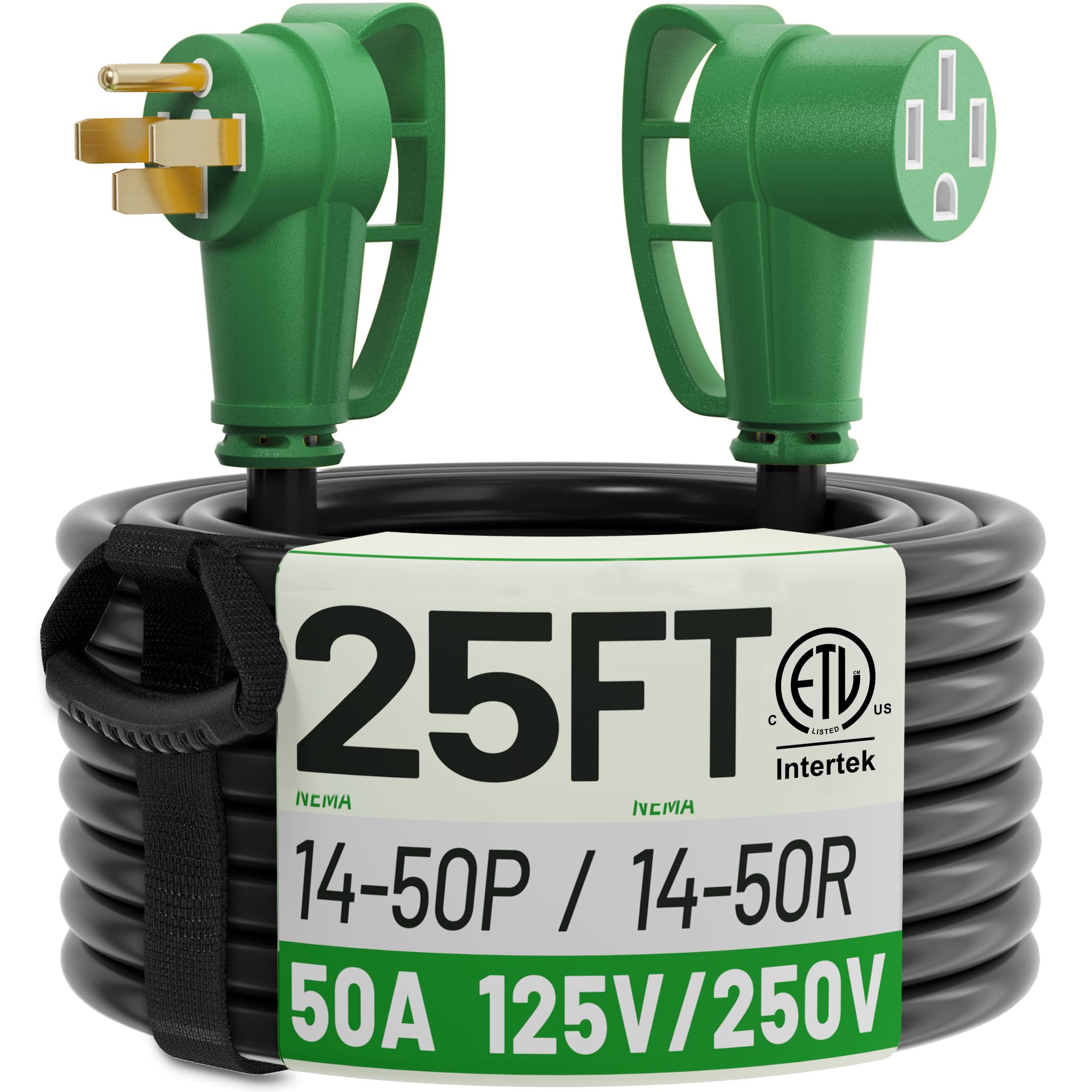
3. POWGRN NEMA 14-50P to 14-50R 25 FT 50 Amp Extension Cord
Twenty-five feet of ETL-listed copper that stays flexible at -40°F and cool under load.
The POWGRN and the VEVOR above are direct rivals — same 25-foot span, same NEMA 14-50P to 14-50R pairing, same 50-amp ceiling. Where this one separates is certification and cold-weather behavior. It carries an ETL listing, an independent safety certification that verifies the cord against published electrical standards, and its jacket is built to remain flexible down to -40°F instead of stiffening into a plank. At 5.85 kg it is also the lighter of the two 25-footers, so hauling it out of the garage asks less of you.
What wins people over is the combination of durability and performance: quality draws 76 mentions, while performance earns 47 and compatibility 21. Weight is the one debated trait, mentioned 10 times with mixed feelings — expect a substantial cable, not a featherweight. Owners mention: “Cord ran RV AC at 77°F, large fridge, 3 fans for 4 days in South Florida heat, saving user and pets.”
The everyday reality: The 25-foot span is long enough to park nose-in or nose-out, and the molded pull handles mean you are not fighting a stuck plug when it is cold and wet.
The caveat: One listing detail is a spec mismatch note — the data lists a gauge value of 1 and a Cat 3 ethernet classification (a network cable rating) that do not belong to a power cord. Buy this on its stated 50-amp, 125/250-volt and ETL facts rather than those odd fields.
Pick this one if: you want a certified 25-foot cord that still coils easily in a cold garage.
Skip if: you need to cover more than about 25 feet from outlet to car.
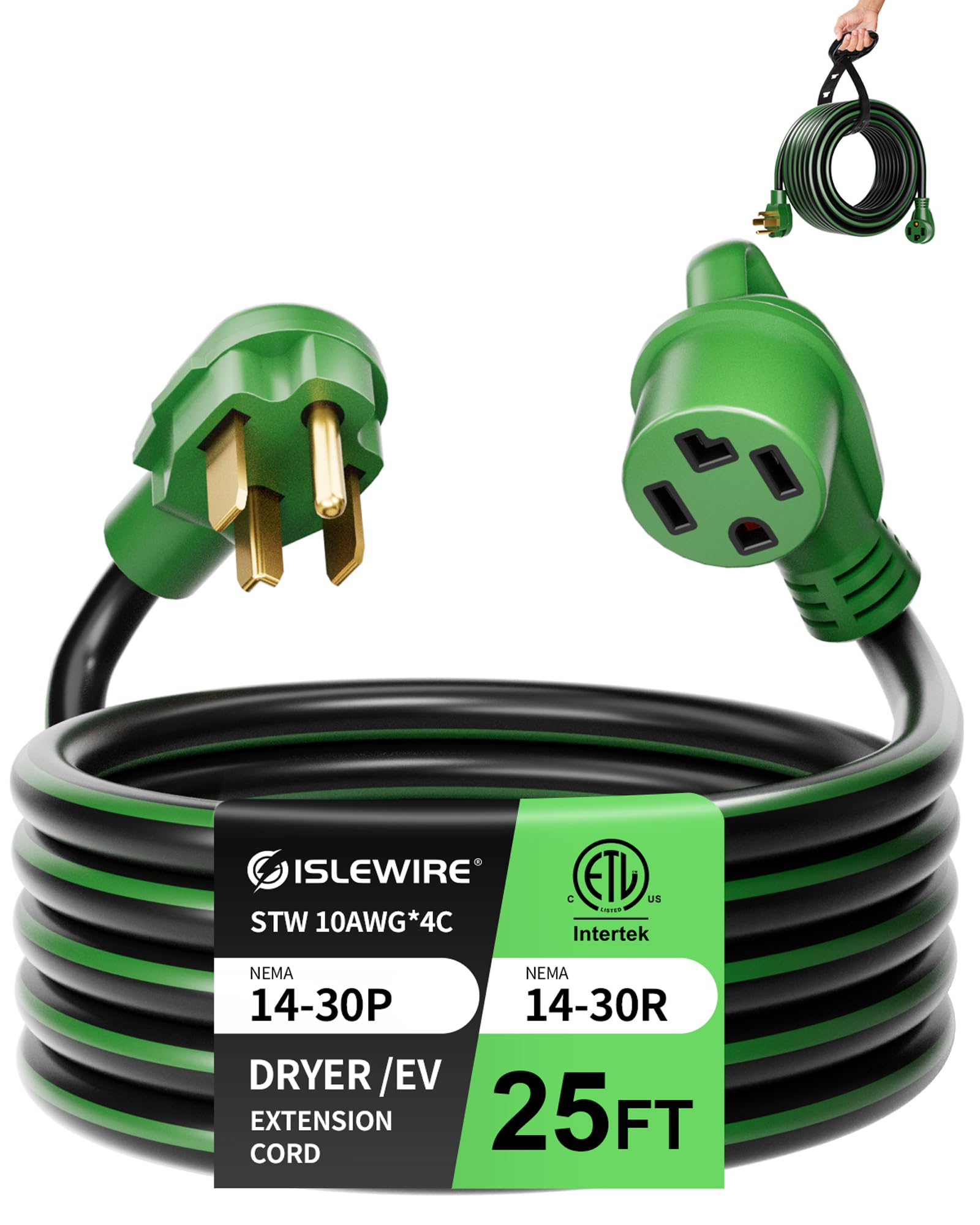
4. 30-Amp 4-Prong Dryer EV Extension Cord, 25 Feet
For the homeowner whose only 240-volt socket hides behind the laundry machines.
Not everyone has a NEMA 14-50 socket in the garage. Plenty of houses have a four-prong NEMA 14-30 dryer outlet instead, and this cord is the bridge. It runs 30 amps at 125/250 volts and up to 7500 watts through 100% pure copper 10AWG wire, moving that dryer circuit out to where your car actually sits. The 25-foot run uses an STW jacket rated for rain, humidity and direct sun, so it works in a garage or on a driveway.
Charging performance deserves the honest framing: buyers charge their Teslas at 24 amps on this cord to avoid pushing a dryer circuit too hard, and the wire stays cool doing it. At that 24-amp draw, one driver reported adding 22 to 24 miles of range per hour — slower than a 50-amp cord, but plenty for overnight top-ups. The right-angle molded plug is a small win too; it sits flush against the wall so the cord does not kink behind an appliance.
The one durability note to hold loosely: several owners call the build strong, though a single report flags the metal plug prongs bending easily — treat the plug end with normal care and it holds up fine. Exactly as described is the recurring sentiment.
Reasons it works
- Turns an unused dryer circuit into a workable car-charging outlet
- 10AWG pure copper stays cool at a 24-amp charging draw
- Right-angle plug fits tight spaces behind a dryer or wall unit
Worth knowing
- 700 watts below the headroom of a NEMA 14-50 cord — expect a slower charge rate
- Only suits cars and connectors matching the NEMA 14-30 shape
Made for: anyone charging from a four-prong dryer outlet who wants a tougher, longer run than a short adapter.
Not the one if: your home has a NEMA 14-50 socket — the 50-amp cords above will serve you better.
5. SEGUMA J1772 EV Charger Extension Cable, 40A 21FT

A J1772 cable, not a wall cord — it plugs into your charger’s handle and buys 21 more feet.
This works differently from the NEMA cords above. Instead of extending a wall outlet, the SEGUMA extends the charging cable itself: it connects to Level 1 or Level 2 chargers that use the J1772 connector (the standard round plug on most non-Tesla EVs and PHEVs in North America). That shapes the numbers — 21 feet of reach, 40 amps of capacity, and 240 volts at up to 9600 watts, with no power loss claimed along the run.
Two details target the real risk with any extension. Silver plating on the inlets improves conductivity and helps prevent overheating, and the 100% copper TPE jacket carries an IP66 waterproof rating — fully protected against heavy rain and spray. At 8.03 pounds it is manageable to coil and stow, and Seguma backs it with a 12-month guarantee plus round-the-clock support.
Be aware of where the mixed reports sit before you buy. Quality is the most-praised trait with 46 mentions, but charging performance draws 26 mixed mentions and connectivity is the most-discussed concern overall. Most owners are charging happily; a handful note the locking mechanism can feel less secure, so check that the connectors lock firmly when you first plug in. Customers note: “Well made with durable connectors. Easy to use and stow away.”
The short version: If your charger is wall-mounted with a tethered J1772 cable that can’t quite reach the car, this is the piece that fixes it without electrical work.
Watch for: Tesla owners need a separate J1772 adapter (not included) — this cable will not attach to a Tesla connector on its own.
Right pick for: J1772-equipped EVs and PHEVs where the charger cable, not the outlet, is the limiter.
Wrong tool if: your problem is a wall outlet too far away — a NEMA cord handles that job.
6. for Tesla Extension Cord 240V, 50A 21FT NACS Cable
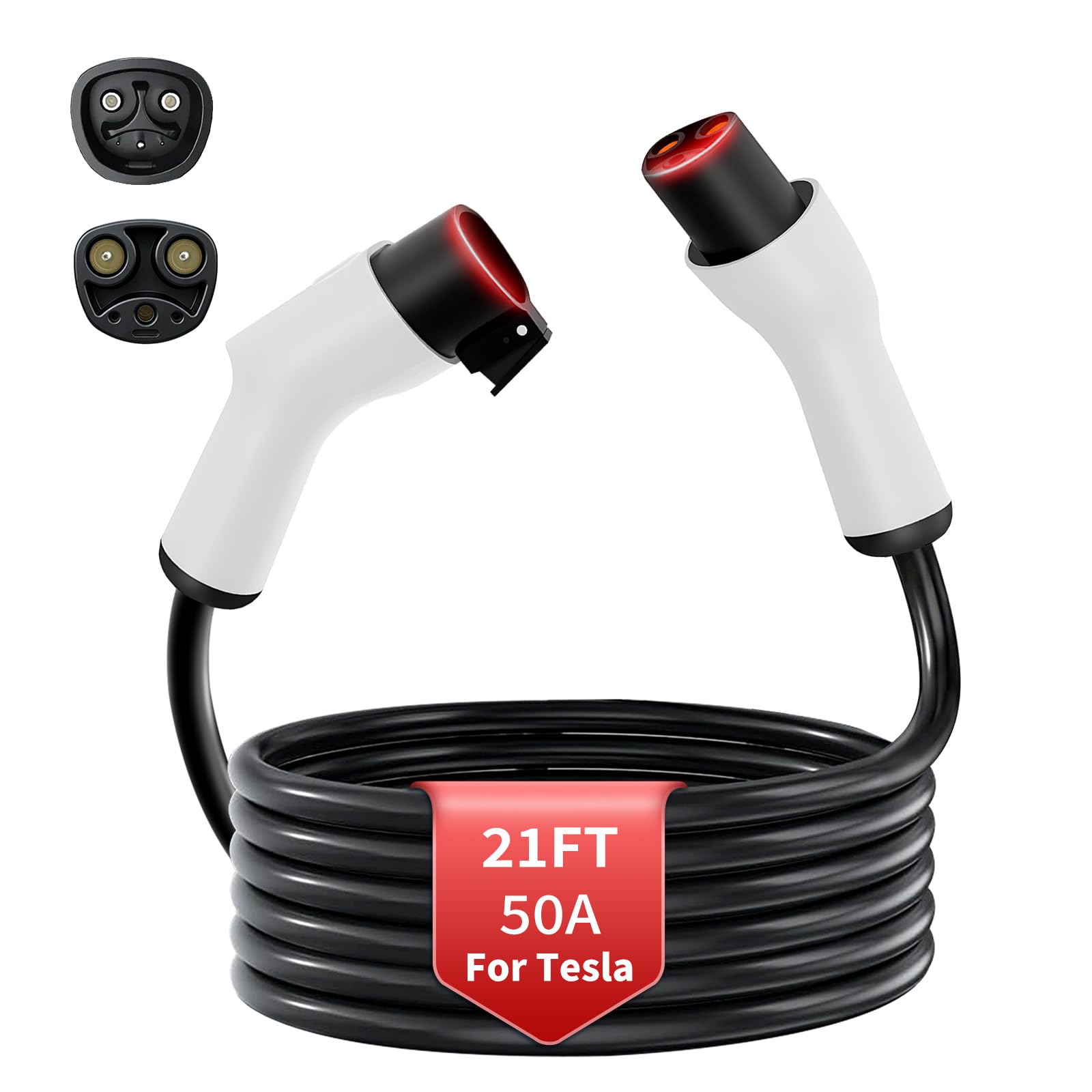
A true 8 AWG NACS cable that adds 21 feet without the bulk of a fat 14-50 cord.
Tesla drivers face two separate reach problems, and this cable solves the more annoying one. Instead of extending your wall outlet with a heavy RV cord, you extend the charging cable itself — the NACS connector (Tesla’s own charging plug shape) slots between your mobile or wall connector and the car. It supports a continuous 50 amps at 240 volts, which covers even the fastest home setups, and owners say the true 8 AWG pure copper core is thicker than the stock cable on a Tesla wall charger.
The build handles weather and cold well. A PC and ABS jacket keeps the cable flexible enough to coil even in -22°F conditions and blocks rain from the connection. At 6.8 pounds it is far lighter than the 19.1-pound VEVOR above — genuinely backpackable if you charge away from home. It also includes a carrying case.
Functionality is what owners rave about, with 23 mentions, and quality follows at 19. Charging speed draws 5 mixed mentions, and a couple of reviewers point out a unit that stopped working after several months — a small minority against a run that most owners describe as reliable for two years and counting. There are two quirks to know: the connector button does not pop open your charge port, and you may need to disconnect the extension from the mobile connector first. Shoppers say: “This works like a charm! Love the ability to have an extension cord without the major heaviness and difficulty with a huge 50 amp extension cord.”
What stands out
- 8 AWG copper core runs cooler than thinner cables under peak loads
- 21 feet adds real reach without a heavy 50-amp RV cord
- Flexible jacket coils easily even in freezing weather
Trade-offs to plan for
- Works only with Tesla charging equipment — not other brands or DC fast stations
- The release button does not open the charge port; you may need to unplug the extension first
The easy call for: Tesla owners who want a light, weatherproof reach extender for home or the road.
Pass if: you drive a non-Tesla EV — the J1772 pieces above match your port instead.
7. SEGUMA EV Charger Extension Cable, 50A 20FT
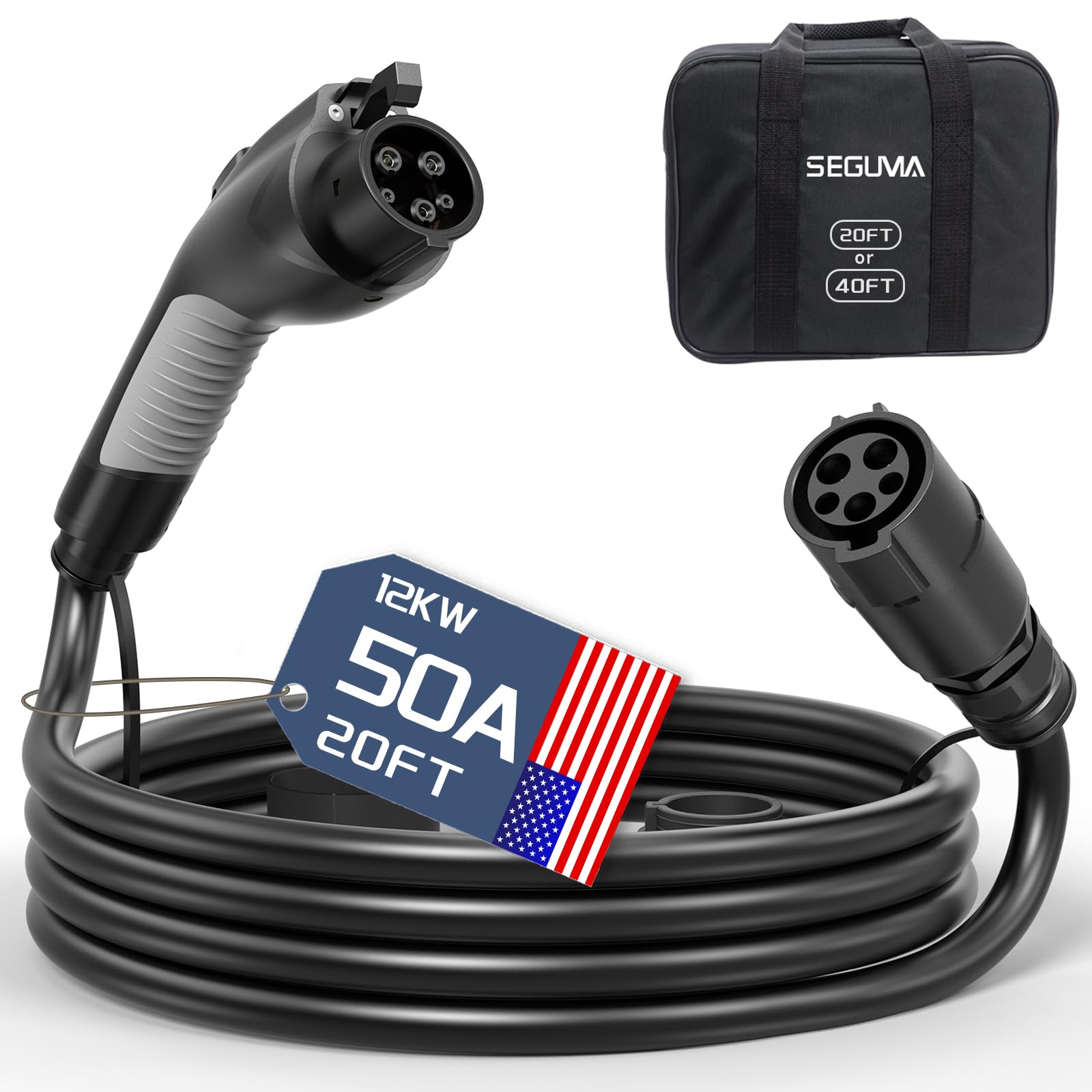
The higher-amp SEGUMA — 50 amps and 12000 watts where the 40A model tops out lower.
If you like the J1772 extender idea but want more ceiling, this is the same maker’s heavier version. It stretches 20 feet and carries up to 50 amps at 240 volts and 12000 watts — a full step above the 40-amp, 9600-watt cable from the same brand, so owners with high-output chargers can push more current. It attaches to Level 1 or Level 2 chargers with J1772 connectors, covering non-Tesla EVs and PHEVs without any rewiring.
Construction follows the same recipe: 100% copper TPE cable, a solid J1772 connector and socket, silver plating on the handle inlet to keep conductivity up and heat down, and an IP66 waterproof rating for all-weather use. At 8.18 pounds it weighs about the same as the 40-amp sibling, so the bigger amp rating costs you nothing extra in the hand.
Functionality is the trait owners praise most, named 29 times, with quality close behind at 21. The longer-range picture is more mixed: charging earns 8 mixed mentions and durability 6, and the data notes some cords run up to two years while others quit around the 18-month mark. Buyers report: “They stand behind their product!” — a note about how the company handles issues, which matters with a cable that lives outdoors.
The honest split: Most owners set this up and forget about it; the durability chatter is the reason to check your connectors once a season rather than the reason to avoid it.
Who loses out: Again, Tesla drivers need a separate J1772 adapter, and this cable only serves the J1772 standard.
Good match for: a J1772 driver with a high-amperage charger who wants 50 amps of capacity and UL-listed construction.
Not for you if: you only need occasional reach — the 40-amp model covers that for less weight and cost.
8. Inteset 21ft 40amp J1772 EV Extension Cord

An American-assembled J1772 extender built to stay soft in the cold and travel light.
Inteset takes a different approach to the same job. This 21-foot J1772 extender is assembled and supported in the USA, using UL recognized connector and cable parts, and its defining trait is the ultra-flex cable jacket — it resists stiffening in cold weather so it coils without a fight. That matters if you charge in a cold-climate driveway where cheaper cords turn into frozen knots. It carries 40 amps of continuous use and works indoor or outdoor at IP65 (dust-tight and water-spray-resistant), though it is not meant to be submerged.
The compatibility list is broad: it fits all Type 1, SAE J1772, Level 1 and Level 2 chargers, covering most non-Tesla EVs and PHEVs, plus Teslas running a J1772 adapter. One clear exclusion — it does not work with the Tesla J1772 Wall Connector. The pin design gets attention too; all pins are machine crimped for conductivity, strength and safety, and the cable ships with a carrying bag for storage between charges.
Functionality leads the praise here with 52 mentions and durability draws 28 — momentum that lines up with its heavy-duty indoor/outdoor role. Value is the debated corner, with 14 mixed mentions, and there is a 2-year warranty standing behind it.
Why it earns a place
- Ultra-flex jacket stays workable in low temperatures for easy coiling
- Machine-crimped pins and UL recognized parts for a secure connection
- 2-year warranty with support from a US-based assembler
Where it stops
- 40 amps, not 50 — high-output chargers get less headroom
- Will not pair with a Tesla J1772 Wall Connector, and does not work underwater
Choose it when: cold weather, portability and US assembly are your priorities over maximum amp rating.
Consider the Seguma 50A instead if: you want the extra 10 amps of ceiling.
9. Nilight 50 Amp 50FT RV EV Extension Cord

Fifty feet of certified 6-gauge copper for the driveway your outlet never expected to serve.
When nothing else reaches, this does. The Nilight spans 600 inches — a full 50 feet — which is double the reach of the 25-foot VEVOR and POWGRN cords above, yet it keeps the same 50-amp rating at 125/250 volts through NEMA 14-50P to 14-50R connections. Its construction uses full 3 x 6 gauge wires plus a 1 x 8 gauge wire, all 100% pure copper, so the thick low-gauge wire keeps voltage drop to a minimum over that long run. That matters because a 50-foot pull stresses the supply more, and thin wire lets the voltage sag right when your car needs it.
Because it carries both UL and ETL certification, you can use it in the U.S. and Canada, and the jacket is a flame-retardant, heat-resistant PVC sheath built to survive wind, rain, snow, soil and rocks. The stranded copper stays flexible enough to coil despite the heavy build, and Nilight includes a drag tool to wrestle it into place. Plan for the weight — this is garage equipment you keep parked where you need it.
Quality is the trait owners call out most with 9 mentions, closely followed by functionality at 8 — a solid, no-drama reception for a cord this size. One thing to check first: only get this if 50 feet genuinely meets your need, because a shorter cord will be easier to manage if it already reaches.
The one question to ask: Do you actually need 50 feet? If your outlet is 25 feet from the car, buy a 25-foot cord and skip the weight and drag of a 50-footer.
Where it shines: Long driveways, wide parking pads, and campsites where the pedestal sits at the far end of the lot.
Made for: the long, awkward gap where nothing under 50 feet will bridge the distance.
Think again if: a shorter cord would already reach — the extra length only adds to manage.
Know the Specs
Amperage (the current ceiling)
Amperage is the maximum current the cord can carry — written as a number followed by “A.” A 50-amp cord typically supports a 40-amp continuous draw, which is why it is the safe pick for overnight EV charging, while a 30-amp cord suits lower-draw circuits. Match the cord’s amperage to your charger’s draw, and leave headroom rather than maxing it out.
Wire Gauge (AWG)
Gauge measures wire thickness, and lower numbers mean thicker wire. A 6-gauge conductor handles more current with less resistance and less heat than a 10-gauge one. Thicker wire also resists voltage drop over a long run, so your charger keeps delivering its full rate on a 50-foot cord, not just a short one.
Connector Type
Connectors determine fit, not performance. NEMA 14-50 is the round four-prong 240-volt socket common for EV and RV hookups; NEMA 14-30 is the smaller four-prong dryer outlet; J1772 is the round charging plug on most non-Tesla EVs and PHEVs; NACS is Tesla’s connector. Check your own plug model before buying — a mismatch means the cord will not connect at all.
Weatherproofing (IP Rating)
An IP rating tells you how well a cord handles dust and water. IP65 protects against dust and water spray, while IP66 adds protection against heavier jets of water — useful for a cord left outside in real weather. None of these ratings mean the cord can be submerged, so keep the ends off the ground when a storm rolls through.
Common Questions
Can I use a regular household extension cord to charge my EV?
Will a 50-amp cord work if my charger only pulls 32 amps?
Do I need a NEMA 14-50 cord or a J1772 cable?
Are these extension cords safe for overnight charging?
Can I leave an EV extension cord outside in the rain?
How do I stop the cord getting hot while charging?
What length extension cord do I actually need for EV charging?
Does a longer extension cord slow down EV charging?
Can I use a Tesla cord on a non-Tesla EV?
Do I need an electrician to install an EV extension cord?
The Bottom Line
For most homes, the extension cords for ev charging winner is the VEVOR 25 FT 50Amp RV Extension Cord — its 6-gauge copper and 50-amp rating give you real headroom for overnight charging, and the threaded locking ring keeps the connection sealed outdoors. If your garage gap is short, grab the PlugSaf 15 FT; for a certified 25-footer that stays flexible in the cold, the POWGRN is the smart call. Tesla drivers who want to extend the cable rather than the outlet should reach for the WenStorm NACS cord, and if raw distance is your problem, the 50-foot Nilight bridges almost any driveway. If your outlet is already close, the PlugSaf covers it without the bulk — otherwise the VEVOR’s balance of certified copper and daily usability is the one to order.
How we choose
We do not accept paid placement. Every pick is matched to a real buyer and a real use-case; we do not hands-on test units.
Sources
Specifications: manufacturer listings and product documentation. Review insights: verified customer reviews, as of October 2026. Pricing: not shown on this page (it changes often); check the current price via the retailer link.
As an Amazon Associate, Home Digitized earns from qualifying purchases. This does not affect which products we feature.